Tap to Act: Designing NFC Flows on Mobile
A tap is faster than a scan until it fails. Designing NFC flows that work in the real world — fallbacks, failure states, and the platform rules that shape the product.
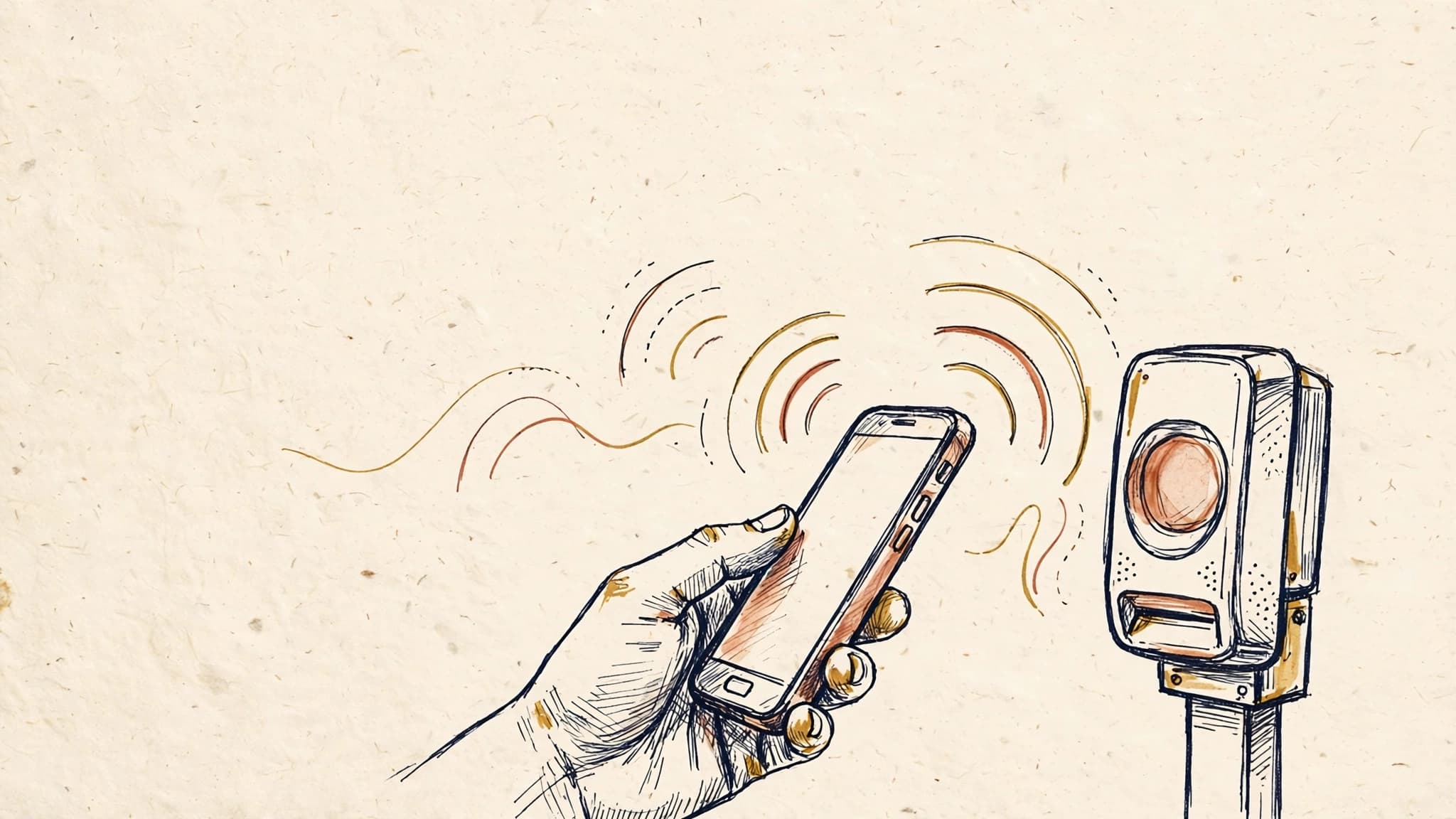
Tap to Act: Designing NFC Flows on Mobile
A tap is the fastest interaction in mobile. No camera to aim, no code to frame, no keyboard to summon — just a phone brought near a thing, and something happens. Transit gates open. Doors unlock. Payments clear. Speakers pair. It feels like magic, which is exactly why it is so unforgiving when it fails.
A failed QR scan is legible: the user sees the camera missed and tries again. A failed tap is opaque. The phone did nothing, or buzzed and did nothing, or opened the wrong thing. The user has no mental model of what went wrong, and no obvious next move. That asymmetry defines the entire product problem of NFC on mobile. The technology is mature and the hardware is everywhere; the design work is almost entirely about the moments around the tap.
This post is about those moments: where NFC genuinely beats other triggers, what happens when the tap fails, and how to design flows that survive the real world — crowded stations, cheap tags, locked phones, and users who have never heard the letters N, F, and C.
Why the tap wins — and where it doesn't
NFC's core advantage is not speed in the abstract. It is the removal of decisions. A QR code asks the user to notice the code, open a camera or scanner, frame it, and wait. A deep link asks them to find a link and tap it. A tap asks for one physical gesture that is already in muscle memory from years of contactless payments. For flows where the user is standing in front of the thing they want to interact with, that single gesture is unbeatable.
Transit is the canonical example. A rider approaching a gate with bags in both hands does not want to unlock a phone, open an app, and display a code. They want to tap and walk. Cities that moved from barcode tickets to NFC — whether card emulation on the phone or a tap-to-pay bank card — consistently see faster gate throughput and fewer missed trains, because the interaction collapses to a gesture people already perform at every checkout counter.
Access control is the same story. Hotel keys, office badges, gym entry: the tap replaces a card the user can lose with a phone they already carry. The product win is not novelty; it is one fewer object in the user's pocket and one fewer support ticket when that object is forgotten.
But NFC loses clearly in other moments, and honest product design starts by naming them. NFC has no line of sight and no discovery mechanism. A user cannot "see" an NFC tag the way they can see a QR code, so the tap only works when the user already knows where to tap — a marked reader, a known poster, a terminal. For marketing content, menus, and anything the user discovers visually, QR wins because the code itself is the affordance. NFC also loses at distance: its range is centimeters, not meters, so it cannot do what Bluetooth beacons do for proximity detection in a store or museum.
The decision rule is simple: use NFC when the user is physically present, the action is one step, and the target is obvious. Use something else when discovery, distance, or explanation matters more than speed.
The tap is a conversation, not a button press
Product teams often treat NFC as a trigger — phone meets tag, app opens, done. In reality, a tap initiates a short conversation with several possible outcomes, and each one needs a designed response.
The happy path is genuinely instant: tag read, action executed, confirmation shown. But between the phone and the tag sit several layers that can each say no. The phone may be locked, and background tag reading behaves differently by platform and OS version. The tag may be damaged, misprogrammed, or a type the phone cannot read. The payload may point to an app the user does not have installed. The network call the action depends on may fail. And the user may simply hold the phone at the wrong spot — NFC antennas live in different places on different phones, and "tap the top of the phone" is not obvious to someone whose last phone had the antenna in the middle.
Each of these failures produces a different user experience if left undesigned. A locked phone that silently ignores a tag teaches the user that tapping does nothing. A tag that opens a browser to an app-store page teaches them that tapping is a chore. A payment terminal that flashes red with no message teaches them to try a different card, then a different phone, then to give up and queue at the ticket machine.
Good NFC products design the whole conversation. The physical target carries a visual cue — a tap mark, a short instruction, a hint about where on the phone to hold. The app confirms the tap immediately, even before the backend responds, so the user knows the gesture registered. And every failure state gets a specific, actionable message: "Hold the top of your phone flat against the reader," not "NFC error." The difference between those two sentences is the difference between a user who retries and a user who abandons.
Designing the fallback before the feature
The most important product decision in any NFC flow is the fallback, and it should be made before the feature is built, not after the first support tickets arrive.
Every NFC flow needs a non-NFC path to the same outcome. For payments, that is a physical card or a displayed code. For transit, a ticket machine or a staffed gate. For pairing, a manual code entry or a Bluetooth discovery list. For access, a keypad or a reception desk. The fallback is not an admission of failure; it is the thing that lets users trust the tap in the first place. Users adopt fast paths only when they know a slow path exists.
The second fallback is inside the flow itself. When a tap fails, the product should degrade gracefully in stages: first, retry guidance ("move your phone slowly across the reader"); then, an alternative trigger ("or scan this code"); then, a human escape hatch ("ask staff" or "contact support"). Each stage should be one tap away, not buried in a help article. The metric that matters here is not tap success rate in the lab — it is task completion rate in the field, counting every path to the outcome.
This is also where NFC beats QR in a subtle way that matters for product strategy. A QR code's fallback is usually "type the URL," which nobody does. An NFC flow's fallback can be another tap-based affordance — a different reader position, a second attempt with the phone unlocked — because the user's intent is already physical and present. Design for the retry, not just the first attempt.
The platform rules shape the product
NFC on mobile is not one technology but two platform stories, and the differences leak directly into product decisions.
On iOS, background tag reading exists but with constraints: it works when the phone is unlocked and the screen is on, and it reads tags containing URLs or certain payload types, routing them to the right app or to Safari. Core NFC in the foreground gives an app full control but requires the app to be open and a scanning session active — which means the user must launch the app first, defeating the pure tap fantasy for many use cases. Apple Wallet passes and NFC-enabled passes get the true tap-and-go behavior, but only through Apple's wallet infrastructure, with its own certification and business requirements.
On Android, the story is more flexible and more fragmented. Host card emulation lets an app present itself as a card to a reader without the app being in the foreground, which is why transit and access apps on Android can feel more seamless. But behavior varies by manufacturer, battery optimization settings can kill background services, and the antenna position differs across devices. Android's flexibility is a product advantage and a QA burden in equal measure.
The practical consequence: the same NFC feature ships as two different products. The iOS version may need an explicit "hold near reader" screen with a scanning session, while the Android version works from the lock screen. Marketing copy that promises "just tap" will be true on one platform and misleading on the other unless the team designs — and messages — each version honestly. Teams that ignore this ship a feature that works in the demo and disappoints in the wild.
NFC vs QR: choosing the trigger is a product decision
The NFC-versus-QR debate usually gets framed as a technology comparison. It is better framed as a question about the user's moment.
Choose NFC when the moment is physical, habitual, and time-pressured: paying, entering, boarding, unlocking. The user is already holding the phone near the target, and every second of friction is felt. The tap's invisibility is a feature here — there is nothing to aim, nothing to read, nothing to decide.
Choose QR when the moment is visual, exploratory, or shareable: a poster, a menu, a product label, a friend's screen. QR codes can be photographed, forwarded, printed, and displayed on a screen that NFC cannot touch. They carry their own affordance — the code is visible, so the user knows something is scannable.
Choose both when the moment is high-stakes and the audience is mixed. Transit systems learned this years ago: tap for regulars, QR or printed tickets for visitors and edge cases. The redundancy looks wasteful on a spec sheet and feels generous in real life. Product teams that insist on one trigger for ideological purity usually end up building the second one anyway, after the complaints.
Measuring what matters
NFC features are easy to measure badly. Tap success rate — the percentage of taps that read a tag — is a hardware metric, not a product metric. It tells you the radios work. It tells you nothing about whether users complete their goal.
The metrics that matter start one level up. Task completion rate: of everyone who attempted the action, how many finished it, by any path? Time to completion: how long from intent to outcome, including retries and fallbacks? Retry rate: how many users needed a second or third tap, and where did they hesitate? And fallback usage: how often does the non-NFC path get used, which is a direct signal of how much users trust the tap.
Instrumentation needs care here, because NFC failures often happen outside the app — a locked phone, a reader that never engaged, a tag the OS swallowed. Teams that only log in-app events will see a clean funnel and a mystery: users who never appear in the data because the tap never reached the app. Pairing in-app telemetry with reader-side logs, support ticket themes, and observed field testing closes that gap. The most valuable NFC research is still standing in a station watching real people tap.
Where NFC goes next
The tap is getting more capable, and the product implications are worth watching. Digital car keys and hotel keys in wallets are normalizing the idea that a phone replaces a pocketful of cards. Tap-to-pay on a merchant's phone — the phone itself becoming the terminal — is turning small sellers into NFC endpoints without hardware. And the steady expansion of wallet passes means more tap flows can live in the OS layer, where they work from the lock screen, instead of inside individual apps.
For product teams, the strategic question is shifting from "should we add NFC?" to "which of our flows deserve the tap?" The answer will rarely be all of them. The tap is a scarce resource of user trust: every time it works instantly, trust grows; every time it fails silently, trust drops faster than it grew. Spend it on the flows where speed matters most and the target is obvious, design the failure states as carefully as the success state, and keep the slow path within reach. A tap that works nine times out of ten and recovers gracefully on the tenth will beat a tap that works ten times in the lab and fails once in the station — because users remember the station.
Takeaways
- NFC wins where the user is physically present, the action is one step, and the target is obvious. It loses on discovery, distance, and explanation — that is QR's and Bluetooth's job.
- A tap is a conversation with many failure modes. Design the response to each one: immediate confirmation, specific retry guidance, and a graceful fallback.
- The fallback is not optional. Users trust fast paths only when a slow path exists, and task completion — not tap success — is the metric that matters.
- iOS and Android NFC behave differently enough that the same feature is two products. Design and message each version honestly.
- When in doubt, ship both triggers for high-stakes flows. Redundancy that feels generous in real life beats purity that fails at the gate.
- Spend the tap on flows where speed matters most, and protect the trust it builds by recovering gracefully when it fails.